



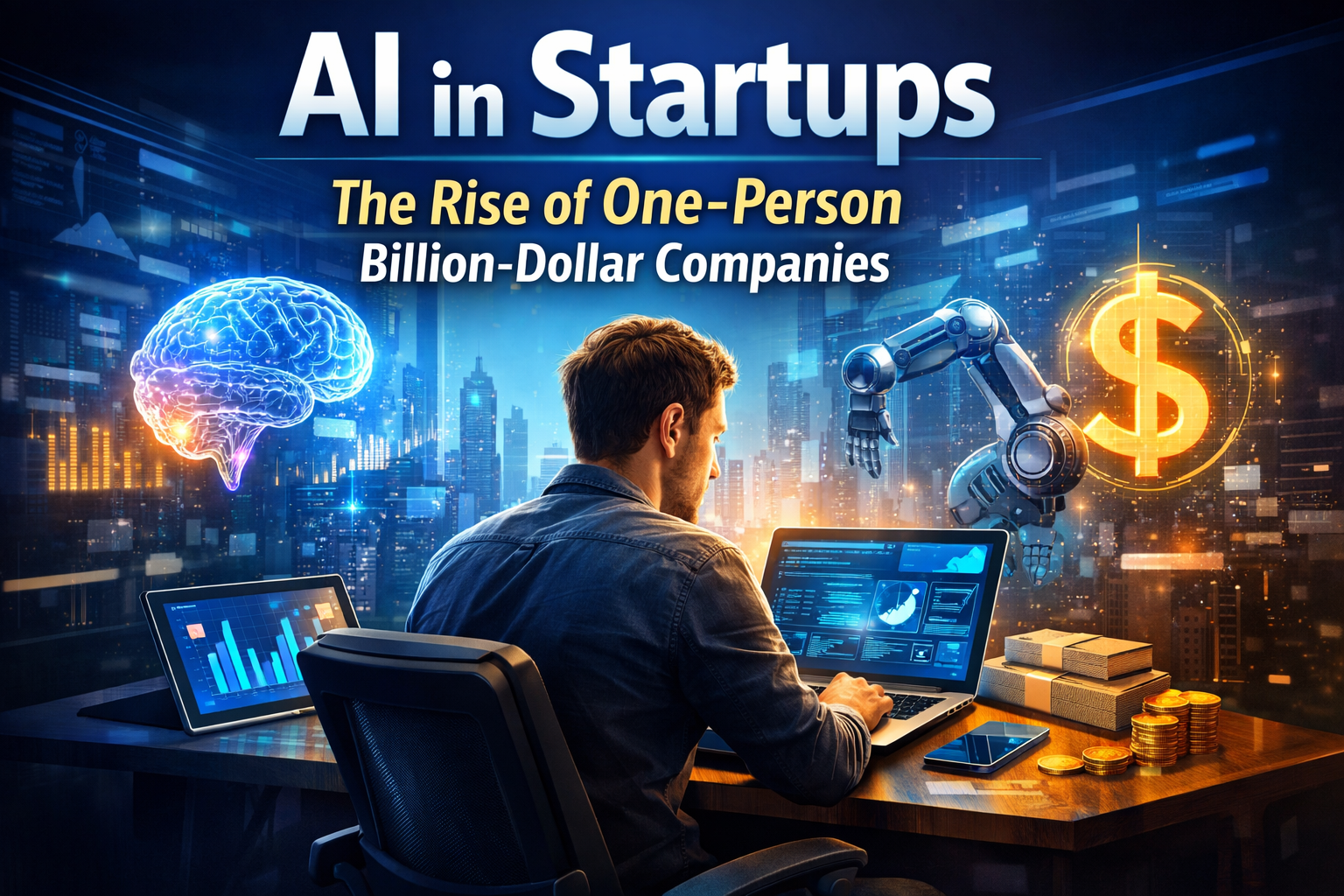
A quiet revolution is happening in the business world and AI in startups is at the center of it. For decades building a billion-dollar company required large teams big funding rounds and years of scaling. Today a single skilled founder with the right AI tools can launch scale and automate a company that reaches millions of users worldwide.
This is not a fantasy story. It is happening right now.
The idea of one-person billion-dollar companies sounds bold yet the foundations are already visible. Solo founders are using artificial intelligence to replace tasks that once required full departments. Marketing customer service product design coding research and even legal drafting can now be assisted by AI systems. This shift is reducing costs increasing speed and opening doors for independent creators in ways never seen before.
In this blog we will explore how AI is reshaping entrepreneurship. We will look at real examples data and practical strategies. We will also break down what makes this movement possible and what challenges still exist.
The Traditional Startup Model vs The AI Startup Model
For years the traditional startup model followed a familiar pattern.
First a founder raised funding.
Then they hired engineers marketers designers and support teams.
Then they built a product tested it and slowly scaled operations.
This approach required capital. It required management skills. It required time.
Now compare that with the AI startup model.
A solo founder can use AI coding assistants to build an MVP in weeks. They can use AI writing tools to create landing pages email campaigns and blog posts. They can automate support using AI chatbots. They can analyze user behavior using machine learning tools without hiring a data science team.
The difference is dramatic.
A 2024 report from McKinsey highlighted that AI could automate up to 60 percent of repetitive business tasks in knowledge work. That means founders no longer need a large staff for many operational roles. Instead they act as orchestrators of intelligent systems.
AI in startups is not about replacing people. It is about amplifying the output of one person.
Why AI in Startups Is Fueling Solo Founders
There are three main reasons why AI in startups is accelerating the rise of solo founders.
1. Automation of Core Functions
Tools like OpenAI APIs GitHub Copilot and Notion AI help founders handle technical and creative work. Marketing automation platforms use AI to optimize ad targeting. Customer support platforms now include AI agents that respond instantly.
A founder no longer needs a support team to answer common questions. They design workflows once and let the system handle thousands of interactions.
2. Lower Cost of Experimentation
In the past building a product prototype required hiring developers. Today no-code platforms combined with AI allow founders to test ideas with minimal cost.
This encourages experimentation. More experiments mean faster innovation.
3. Global Reach from Day One
AI tools help localize content translate messaging and personalize communication at scale. A solo founder can target customers across multiple countries without building international offices.
Platforms like Stripe Shopify and AWS provide infrastructure. AI adds intelligence on top of it.
According to data from Crunchbase there has been a steady increase in solo-founded startups receiving funding over the last three years. Investors are recognizing that lean teams powered by AI can move faster than large traditional companies.
Real Examples of AI in Startups Driving Solo Success
This trend is not theoretical. There are founders who are already building high revenue businesses alone or with very small teams.
Case Study 1: The AI SaaS Founder
In 2023 an independent developer launched an AI writing optimization tool targeting e-commerce brands. Instead of hiring a team the founder used AI to write code documentation and marketing copy. Customer onboarding emails were automated using AI personalization tools.
Within 18 months the product reached over 5000 paying customers. Revenue crossed seven figures annually. The founder managed operations with only two part-time contractors.
The key lesson was focus. The founder did not try to build everything. They used AI to handle repetitive tasks and focused their energy on product improvements and partnerships.
Case Study 2: Content Creator Turned AI Entrepreneur
A content creator built a niche audience in personal finance. Later they launched an AI powered budgeting tool for freelancers. They used machine learning APIs to analyze spending patterns and generate insights.
Marketing was driven by AI assisted content and automated funnels. The product grew quickly because it solved a clear problem for an existing audience.
If you are interested in financial innovation you can also read more about Finance to explore how AI is transforming money management and investing.
These examples show that AI can help startups works best when combined with domain knowledge and audience trust.
The Tech Stack Behind One-Person Billion-Dollar Companies
Let us break down the typical stack used by solo founders today.
- AI coding assistants
- Cloud infrastructure like AWS or Google Cloud
- Payment processing via Stripe
- AI driven analytics tools
- Automated marketing systems
- AI customer support agents
According to McKinsey’s State of AI report companies adopting AI deeply into operations report higher revenue growth compared to peers.
Another trusted resource Gartner research projects massive growth in AI software spending which shows that the ecosystem supporting AI in startups is expanding fast.
This infrastructure allows solo founders to operate at scale without traditional overhead.
The Mindset Shift Required
Technology alone does not create a billion-dollar company. Mindset matters.
Solo founders in the AI era think differently.
They focus on leverage.
They document processes early.
They design systems instead of doing everything manually.
One founder I interviewed shared a simple rule. If a task repeats more than three times it must be automated. That discipline allowed them to scale without burnout.
AI rewards those who treat automation as a habit not an afterthought.
Risks and Limitations of the Solo Founder Model
It is important to stay realistic. Not every startup can be run by one person forever.
Complex industries like biotech hardware manufacturing and heavy infrastructure still require large teams. AI helps but does not replace physical operations.
There is also the risk of overreliance on automation. Poorly trained AI systems can create errors. Founders must review outputs carefully.
Security is another issue. Handling customer data requires compliance with regulations. Solo founders must invest time in understanding privacy laws.
For practical startup advice you can also explore more guides that break down step by step frameworks for building sustainable businesses.
The key takeaway is balance. AI provides leverage but strategic thinking remains human.
What Makes a One-Person Billion-Dollar Company Possible
Three elements increase the odds.
Product With High Margins
Digital products software and platforms scale easily. High gross margins allow profitability without huge teams.
Strong Distribution
Many successful solo founders start with an audience. This reduces customer acquisition cost.
Deep Niche Focus
Instead of targeting everyone they solve a specific problem extremely well.
A founder building AI tools for legal contract review focused only on small law firms. This niche clarity allowed them to dominate a small but valuable market before expanding.
AI in startups works best when paired with narrow positioning.
Data Supporting the Solo Founder Era
A 2024 survey by Indie Hackers showed a rise in founders building profitable SaaS businesses without venture funding. Many reported using AI tools daily for development marketing and customer engagement.
Y Combinator partners have also mentioned publicly that small teams with strong AI integration are achieving milestones faster than larger teams did five years ago.
These signals show a clear pattern. Efficiency is increasing. Capital requirements are decreasing.
This does not guarantee billion-dollar outcomes but it changes the math.
Practical Steps to Leverage AI in Startups Today
If you want to operate like a solo founder in the AI era here are actionable steps.
- Map every recurring task in your business.
- Identify which tasks can be automated with AI tools.
- Start with marketing and customer support. These are often easiest to automate.
- Use AI analytics to understand user behavior early.
- Keep fixed costs low until product market fit is clear.
One founder shared that moving from manual onboarding emails to AI personalized flows increased conversions by 18 percent. Small optimizations compound over time.
AI in startups is not about replacing creativity. It is about freeing time for higher level decisions.
The Human Element Still Matters
Despite automation relationships remain critical.
Customers trust brands built by real people. Transparency and storytelling still drive loyalty. The most successful solo founders share their journey openly. They build community.
AI handles operations but vision empathy and strategy come from humans.
That balance defines the solo founder era.
Conclusion
AI in startups is reshaping what is possible for independent entrepreneurs. The idea of one-person billion-dollar companies no longer feels unrealistic. It feels like a natural outcome of technological leverage.
Automation reduces overhead. Intelligent systems scale operations. Cloud infrastructure supports global reach.
Yet success still depends on clarity focus and execution. AI is a tool not a shortcut.
The founders who win in this new era are those who combine deep domain knowledge with smart automation. They think in systems. They move fast. They stay lean.
We are not witnessing the end of teams. We are witnessing the rise of powerful individuals who can build at a scale once reserved for corporations.
The solo founder era has arrived and AI in startups is the engine driving it forward.